⬤  Launching June 12, 2026

Visual Edge

How to See a Better Game
By Richard Hughes  ·  With Matthew Rudy

Publication Date June 12, 2026
--Days
:
--Hours
:
--Minutes
:
--Seconds
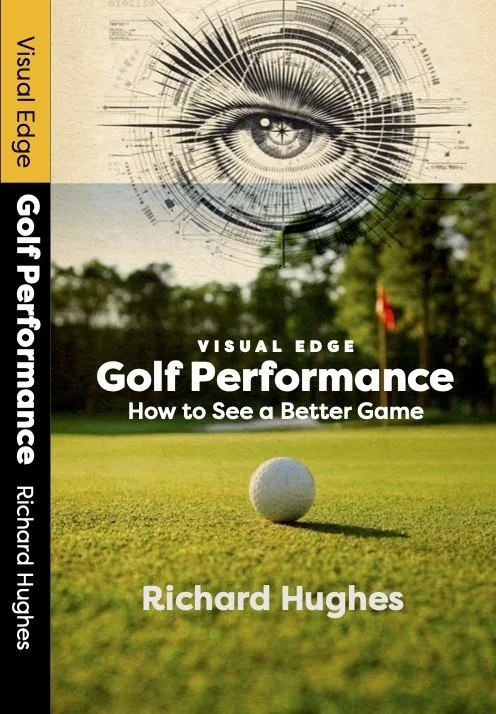
Visual Edge book cover

Why do dedicated golfers hit a ceiling —
no matter how hard they practice?

The answer isn't in your grip. It isn't in your posture. For millions of golfers, it lives somewhere far more fundamental — in the way your visual system feeds information to your brain before you ever take the club back. Eye dominance shapes how you perceive space, align to the target, and process the putting line. Yet in four decades of golf instruction, it has been almost completely ignored.

~70%
of the general population is same-side dominant — the dominant eye and dominant hand on the same side of the body.
General population optometry data
>50%
of elite tour professionals tested at the 2023 Irish Open were cross-dominant — the opposite of what population data would predict.
Hughes et al. — 2023 Irish Open research
4
decades of clinical optometry practice, applied to golf for the first time in a framework that coaches and players can immediately use.
Richard Hughes, Author of Visual Edge and Sports Vision Performance Specialist
The Core Framework

Two Types of Golfer.
One Overlooked Variable.

Eye dominance determines how your visual system organizes space. The game has been teaching the wrong model to most of its players — because its most influential teachers were the minority type.

Type I

Same-Side Dominant

Right handed, right eye dominant

The most common visual configuration in the general population. Type I golfers have a clean, direct visual line to the target — but they are also the most vulnerable to disruption from excess shoulder rotation, which moves the dominant eye out of position at the critical moment of the swing.

The coaching methods that defined modern golf were built largely by observing cross-dominant players. Type I golfers have been working against the grain of almost everything the game has taught them.

"Practice does not fix a visual problem. It encodes it." — Richard Hughes
Type II

Cross-Dominant

Right handed, left eye dominant

Significantly over-represented among elite tour professionals. Type II golfers have their dominant eye closest to the target in a typical address position. Major champions from Jack Nicklaus to Padraig Harrington belong to this visual type.

Cross-dominant players enjoy the accidental advantage of a teaching tradition built in their image — but are not exempt from the visual instability, binocular imbalance, and dominance shifts that affect performance under pressure.

At the 2023 Irish Open, more than 50% of tour professionals tested were cross-dominant — a striking inversion of population norms.

"The eyes perceive, the brain receives, and the body reacts. Every mechanical element of the swing is downstream of what the eyes are telling the brain."

— Richard Hughes, Visual Edge
Inside the Book

Science, Application, and Coaching in the Field

Three sections that take you from clinical understanding to on-course application — with case studies written by the coaches and researchers themselves.

Section 01

The Science

How binocular vision works, how eye dominance is determined, and why the visual system is a dynamic — not fixed — instrument that changes across a round, a season, and a career. Includes groundbreaking research from two of the world's leading vision scientists.

Section 02

Know Your Type

The traits, tendencies, and game of Type I and Type II players. How to identify your visual type, what it means for your setup, swing mechanics, and putting alignment — and how elite coaches are applying this framework with professional and amateur players right now.

Section 03

Correction & Troubleshooting

Practical protocols for addressing dominance instability, binocular imbalance, and the visual drift that causes miss patterns no mechanical fix can resolve. Including how to identify the yips as a vision problem — and what to do about it.

Contributors & Case Studies

The Experts Who Put This to the Test

Visual Edge is built on first-hand accounts from major winners, tour professionals, elite coaches, and world-leading researchers in visual science — each contributing from their own experience working with this material.

Championship-Level Professional Tour Players
Pádraig Harrington
3-Time Major Champion · World Golf Hall of Fame 2024 · 8× Ryder Cup
Three-time major winner (The Open 2007–08, PGA Championship 2008), two senior major titles, and European Ryder Cup Captain in 2021. Padraig shares his career-long relationship with sports vision, including why glasses on the course were never comfortable — and what that meant for his game.
Niall Kearney
3× Irish PGA Champion (2014, 2015, 2024) · DP World Tour · Walker Cup 2009 · Brabazon Cup
A Dublin-born professional who has competed on the DP World Tour and European Challenge Tour, Niall spent fifteen years compensating for a putting alignment problem he could never fully explain — the line on his ball consistently appeared to point left. Testing with Richard Hughes revealed unstable eye dominance and an undiagnosed astigmatism caused by laser surgery two decades earlier. His case study is one of the most detailed accounts in the book: what the testing found, what corrective lenses changed immediately, and how his entire pre-shot routine and green-reading approach is now being rebuilt on a visual system he can finally trust.
Peter Lawrie
2× DP World Tour Winner · 2003 Sir Henry Cotton Rookie of the Year · Irish Amateur Champion 1996
After nearly a decade away from competitive golf, Peter worked with Richard Hughes to develop specialized prescription lenses. In 2024, in his debut on the Legends Tour, he finished 29th at the Senior Open Championship at Carnoustie. His case study is one of the book's most compelling.
Scientists & Researchers
Dr. Peter Allen
Professor of Optometry & Visual Science · Anglia Ruskin University · Medical Advisor: R&A, DP World Tour, LET
Director of the Vision and Eye Research Institute at Anglia Ruskin University and member of the medical and scientific advisory boards for the R&A and European Tour Group. Dr. Allen's chapter establishes the emerging clinical evidence base linking laterality to golf performance.
Dr. Brendan Barrett
Professor of Visual Development · University of Bradford · PhD, University College Dublin
Graduated from the Dublin Institute of Technology and was awarded his PhD from University College Dublin. Professor Barrett's expertise in binocular vision and visual development provides the peer-reviewed science foundation underpinning the book's central framework.
Geraint Griffiths
Sports Vision Specialist & Researcher
Contributes a research perspective on how visual performance factors interact with elite sport — and why the golf world has been slow to integrate findings that other sports have embraced. His case study outlines the frontier of this work.
Elite Coaches
Michael Jacobs
Golf Digest Top 10 Teacher in America · GOLF Magazine Top 100 · 2025 PGA National Professional Development Award · jacob3d.com
With more than 25,000 lessons given and students who have won major championships, professional and amateur titles on every major tour, Michael Jacobs is one of the most analytically formidable instructors in the game. The only golf instructor to have designed his own research software — measuring the forces and torques at work in a swing — he has co-authored academic papers with Dr. Nesbit and authored three books: Elements of the Swing, Swing Tips You Should Forget, and The Science of the Swing. Recognized by the PGA of America with the 2025 National Professional Development Award and the 2020 Horton Smith Award for educating fellow professionals, he was also the keynote speaker at the 2017 PGA Teaching and Coaching Summit across America, Britain, and Finland.
John Jamieson
Mental Performance Coach & Sport Scientist
Contributes from the mental performance and psychophysiology side — how visual confidence, fixation, and dominance stability are linked to competitive pressure responses, and why the mental game and the visual game are far more connected than coaches have recognized.
Michael Kennelly
Elite Golf Coach · Glenlo Abbey, Galway · Ireland
One of Ireland's leading coaches, working with touring professionals and elite amateurs. Based at Glenlo Abbey in Galway, Michael describes how his collaboration with Richard Hughes reshaped the first question he asks at every lesson — and what he now sees that he could never see before.
Gary Madden
PGA Professional & Coach · Glenlo Abbey, Galway · Ireland
PGA golf professional based at Glenlo Abbey. Gary caddied for his student Áine Donegan at the 2023 and 2024 U.S. Women's Open. His case study traces how years of coaching Richard's son Colm — a plus-two or plus-three player — opened the door to this collaboration and transformed his teaching practice.
Mike Magher
CEO & Head Coach · American Golf Academy, Morocco & France · Former DP World Tour Professional
After ten years as a touring professional, Mike built Europe's first elite college golf program in France. He consulted with the Chinese Golf Federation on elite junior development in 2025. Mike writes about eye dominance training as a foundational element of his putting instruction — and why no other performance variable has changed his coaching more.
David Mortimer
Head Professional · Galway Golf Club · 2× Irish PGA Champion · British PGA Champion
Head Professional at Galway Golf Club and one of Ireland's most decorated club professionals. David's chapter focuses on the putting yips — a condition he has now come to understand primarily through the lens of visual dysfunction rather than psychology alone. Transformative reading for any coach or player dealing with the yips.
Scott Munroe
GOLF Magazine Top 100 Teacher in America · PX3 Performance Golf Schools
Developed golf schools and academies for Jack Nicklaus in Australia, Jim Flick at the Nicklaus Flick Golf Schools, and Hank Haney. In 2011, founded the PX3 Performance Golf Schools. With more than 35 years of teaching experience, Scott describes why eye dominance testing has moved to the front of his assessment process.
Rick Silva
GOLF Top 100 Teacher · Founder, Movement3 · movement3golf.com
Rick Silva bridges the gap between theoretical research and science-driven teaching — one of the first instructors in America to build his own 3D-capable studio and apply advanced biomechanics to performance. The founder of Movement3, developed over 20 years of full-time instruction, Rick is a Class A PGA Professional with advanced certifications in Jacobs 3D, TPI, NG|360, Golf Bio-Mechanics, and Manzella. Before launching Movement3 in 2010, he served as Director of Instruction for Discovery Land Co., working across properties including The Madison Club and Gozzer Ranch. He has coached PGA Tour professionals, a U.S. Amateur Champion, a Walker Cup team member, and dozens of NCAA, MLB, and NFL athletes.
About the Author

Why Listen to Richard Hughes?

I've spent four decades as a clinical optometrist. For most of that time, golf was something I played on weekends. Then I started noticing that the players I worked with — at every level — were struggling with problems no amount of practice was fixing. And none of their coaches were looking at the one variable I was trained to examine.

Eye dominance shapes how your brain organizes space, where you aim, and how your motor system responds to what your eyes tell it. It's foundational in clinical optometry. In golf instruction, it was being ignored entirely — or addressed with a quick test that told you almost nothing useful.

I took my instruments to the range and, eventually, to the 2023 Irish Open, where we tested elite tour professionals. More than half were cross-dominant — the opposite of what population data predicts, and the opposite of what most instruction assumes. The implication is hard to escape: the game has been teaching the wrong model to the majority of its players for generations.

Visual Edge is the result of twenty years of applied work. It's built with coaches and scientists I respect, and written for anyone who has worked seriously at this game and still can't figure out why it isn't working.

SpecializationSports Vision Optometry · Eye Dominance & Athletic Performance
Experience40+ years clinical practice, 20+ years elite sports vision specialty
Research2023 Irish Open · DP World Tour · Elite Amateur & International Rugby
Co-written withMatthew Rudy, co-author of more than 20 golf books with coaches including Michael Jacobs, Bernie Najar, Stan Utley, Tony Ruggiero, Dave Stockton, and Hank Haney
Who This Book Is For

This book is honest about who it most urgently serves.

The Dedicated Amateur

You have been taking lessons for years and still cannot figure out why your game never consistently reflects the work you put in. The answer you've been looking for may not be mechanical.

🏆

The Elite Player

You have gone through stretches where your form dropped off for no reason you or your coach could identify. This book will give you a new category of explanation — and a path back.

📐

The Coach

You have watched talented players struggle with instruction that looks correct on paper but doesn't translate to the course. Visual Edge may be one of the most useful things you read this year.

Be the First to See a Better Game

Visual Edge launches on June 12, 2026. Register now to be notified on publication day and receive early access updates from Richard Hughes.

No spam. One email on launch day. Unsubscribe any time.